Cuba Solidarity Campaign - Young Trade Unionist May Day Brigade 2025

As someone sceptical of the idea of ‘international solidarity’ it was with eyebrow raised that this May I flew to Cuba as a union delegate with the Cuba Solidarity Campaign. I was unsure of what to expect, but what I saw opened my eyes.
Along with 41 other UK delegates and over 250 delegates from other countries, we spent 27 April – 9 May in Cuba as part of the 16th International May Day Brigade. The idea of the brigade is to help educate delegates about Cuban life and society, beyond the headlines we are often exposed to in the West, which give a one-sided view of the country. The programme consisted of a range of visits, meetings, and voluntary work.
For the majority of the visit, we stayed at the Julio Antonio Mella International Camp in a province called Artemisa, around 40km outside Havana. The camp was basic in its facilities, with communal rooms, showers, and regular power cuts (an effect of the ongoing US blockade). Walking around the camp, it was apparent that it had seen better days, having been built in the 1970s – there was evidence of sports facilities no longer in use. This was to be a common theme, as the Cuban government is forced to focus their resources on core infrastructure to meet the basic needs of the population.
Initial Days (28– 30 April)
Monday saw us gather with delegates from around the world to open the camp officially. Every group had different banners, and chants, all expressing solidarity with Cuba. We were welcomed by Fernando Gonzalez, one of the ‘Cuban Five’ and President of the Cuban Institute for Friendship between the Peoples (ICAP). As part of the opening, we planted a tree to commemorate ICAP’s 65th anniversary, and learned about the work ICAP does. The support Cuba receives from other countries is extremely important to them, not just financially, but morally too.
Later that afternoon we heard from Professor Raúl Capote, a lecturer and journalist who had been recruited by the CIA in his youth to act as a potential future leader of opposition to the government. Capote had exposed these plans at the last moment, acting as a double-agent.
One important part of the brigades is voluntary aid, and we had the opportunity to collect this aid together for distribution on Monday evening. It was impressive to see what everyone had brought, but also a realisation that basic things such as ibuprofen, that we take for granted, are in short supply in Cuba.
On Tuesday we visited the university in Artemisa, the University of Artemisa Julio Diaz Gonzalez, one of the newest in the country. We spoke to members of the faculty and students from the Federation of University Students, who explained that while the university specialises in agriculture, it also aims to shape students morally and help them to be of service to Cuban society. For example, they helped in recovery efforts after a hurricane hit the area. It was interesting to learn that Cubans not only attend university for free, but that jobs are selected for them post-university, less freedom of choice, but more security. There are separate specialist schools for those who wish to pursue arts subjects such as music or dance.
The afternoon involved a trip to a polyclinic in Caimito, to hear from staff there about the Cuban medical system. The clinics in Cuba are focused on treating individuals holistically, looking at medical issues from all angles, and this clinic had several years with no cases of infant mortality. During the visit, medical aid was presented to the polyclinic, which they gratefully received.
To close the day was a fantastic celebration known as ‘International Night’ where delegates from around the world put on performances and shared aspects of their culture with each other. At the UK stand, we proved overwhelmingly popular with our union merch, cakes, and sweets. If you see a Cuban with a TSSA pen or badge in future, they likely got it from our stand that night!
A highlight of the trip came on Wednesday, when we visited the Luyanó Train Maintenance Depot in Havana, to hear from Cuban railway workers, including the Depot Director and Director of Passenger Services. Cuba was one of the first countries in the world with a railway – before even Spain- due to the need to transport sugar.
The staff were peppered with questions from the rail unions, and we learned that most rolling stock is now supplied by China, which cannot run as efficiently as they would like due to reliance on obsolete equipment. The condition of the rails as we travelled around was evidence of this. A member of the transport union explained how they are involved at all levels with the company, and the collaboration they have with the government to improve services. Unlike in the UK, an 11-coach train in Cuban has over 30 staff members on board, including four drivers, two conductors, cleaners and security staff. Stations are unstaffed, as they were low-paid jobs that were difficult to recruit for. All staff were very focused on the passengers, including one member who was awarded a medal for 55 years’ service – something we can all rightly be proud of!
TSSA should continue to forge links with the transport union in Cuba, as there is much mutual learning to be shared here. It was a real moment of pride to stand in solidarity with RMT and ASLEF colleagues at the depot.
May Day
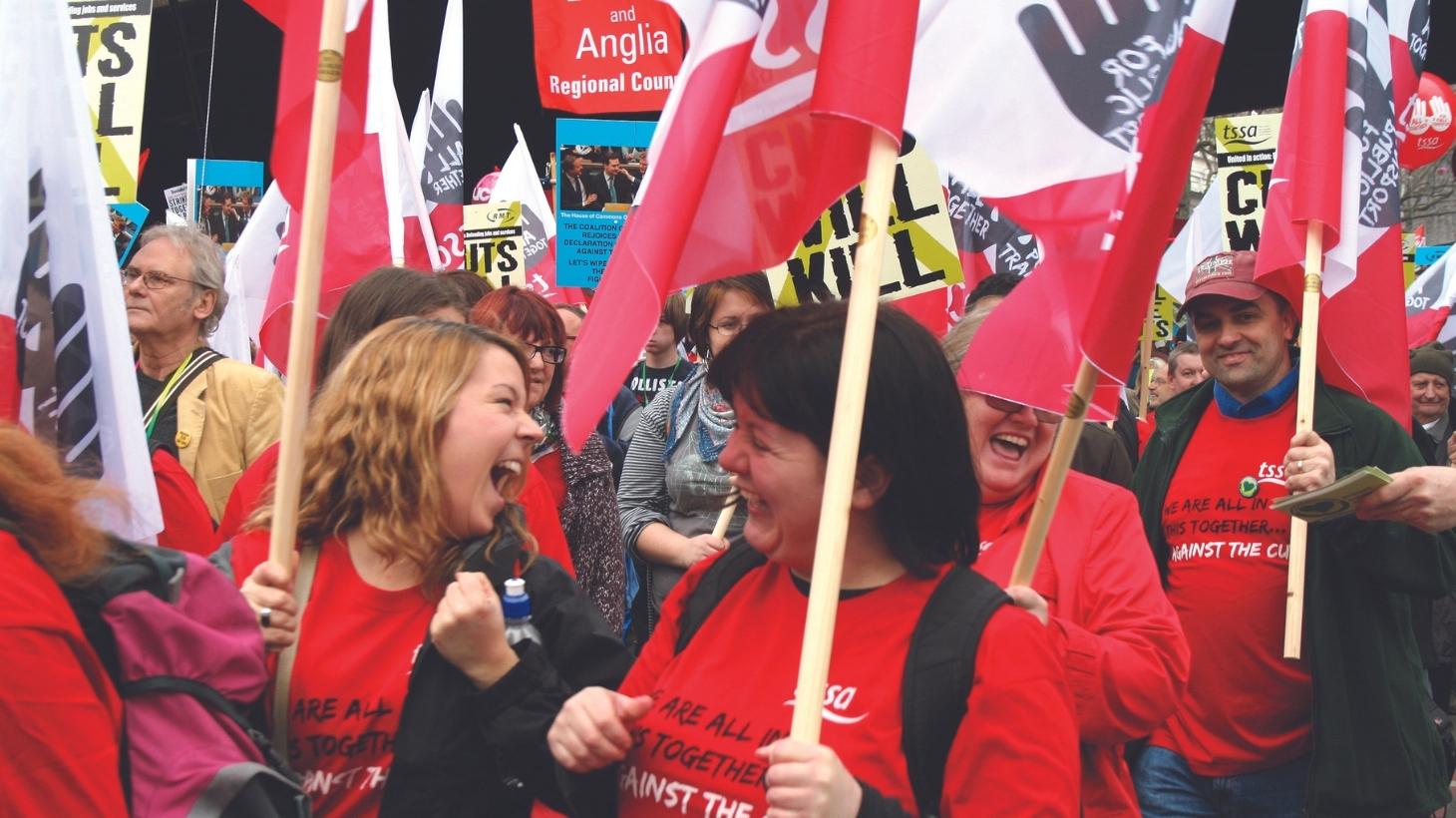
We awoke early on the 1 May to attend the first full May Day celebration since before COVID. In Cuba, May Day sees workers across the country marching in celebration, and many workers are invited to the capital to the Plaza de la Revolucion to march in front of political leaders including the Cuban President and Raul Castro. Although it felt slightly strange to be standing somewhere that resembled something from a documentary about the Cold War, there was real happiness on the faces of those marching. I flew the TSSA flag proudly to represent our great union!
2 May
On Friday we visited the Conventions Palace, a former luxury resort for the pre-Revolutionary elites that has been turned into a political building by the government. As part of the International Meeting of Solidarity with Cuba we heard from groups across the world expressing solidarity with Cuba. One speaker from the Machinists Union in the United States spoke clearly about the need for a simple list of demands to be made of U.S. politicians.
In the afternoon, we had some free time, and I travelled into Havana with a few of the other delegates. Haggling in the market was a good experience. Later, we met a local in a café who spoke to us about the situation in Cuba, explaining how there are difficulties with corruption in Cuba and different factions vying for power. The government is also reliant on China for much of its trade. It was important to see a different side of things, one that was less sanitised.
Voluntary Work
Over the next few days, we took part in a range of voluntary work, the first visit being to an agricultural co-operative in Artemisa. We learned from the workers about the structure of the business, that allows all farmers a say in what crops they grow and where money is invested. The farm supported around 600 people, both workers and their families. Weeding in the sun was tiring work but rewarding! We also travelled to a nearby village to see a community arts project, and donated supplies to the schoolchildren there.
Villa Clara
We spent the next day travelling to Villa Clara province. Over the next few days in Villa Clara, we visited a university, historical sites, workplaces, and carried out some more agricultural voluntary work.
One highlight of our time in Villa Clara included the chance to speak to some veteran combatants of the Association of Combatants of the Cuban Revolution, who had fought in the Bay of Pigs. They explained to us how they were often only young and poorly trained but were motivated by a sense of responsibility to defend their country. Another important visit was to the tomb of Che Guvera, where we were not allowed to take pictures.
One of the workplaces we visited, Reluxes Herreria, was one of the new privatised businesses set up within recent decades with the support of the government. It was a blacksmiths that manufactured metal products such as gates and bed frames to suit local need. From speaking to the director, one got a sense of unease at times and it was obvious this new business model required defending. For example, when asked what his salary was compared to the workers, he initially appeared reluctant to tell us before admitting it was twice that of the worker.
One other important meeting in Santa Clara was with members of the National Programmes for the Advancement of Women and against Racism and Racial Discrimination. They explained to use that violence against women in Cuba is rare and that they had worked to extend maternity pay to 15 months fully paid, which can also be shared with the father. Cuba has one of the highest female representations in politics at 55% of MPs, and 85% of university graduates are women.
We travelled back to the camp in Artemisa on the 8 May, and spent the afternoon listening to how we can support CSC and Cuba within our unions, encouraging our branches to affiliate to CSC. On our last day, 9th May, we visited the Center for Genetic Engineering and Biotechnology, and heard about the work of the Center in developing a vaccine independently during COVID. It was also interesting to hear that despite the blockade, Cuban scientists and researchers are able to work with scientists in other countries, including the UK, where one of our hosts had studied in Manchester!
Conclusion
We left Cuba feeling exhausted but pleased to have seen and experienced so much of the country. For me personally, I left feeling as though I had learned that much of what we are asked to take as inevitable about our current political and economic systems is not so, and that the UK is in the condition it is is because of deliberate political choices made over the years. Cuba demonstrates that even limited resources can be marshalled to benefit citizens.
At times it was difficult to separate fact from fiction, particularly as most of the visits were organised and many were to state enterprises. Some Cubans are clearly unhappy with their government and the system they live under, and as a Catholic, I could see the uneasy relationship that existed between church and state in areas. However, having been to Cuba it is clearer than ever to me that the blockade harms ordinary Cubans most of all, and cannot be justified. We should all work to pressure those in power to encourage an easing of restrictions on Cuba, so that many of those wonderful people we met on our trip have a chance to live more securely and achieve more greatly in their lives.